
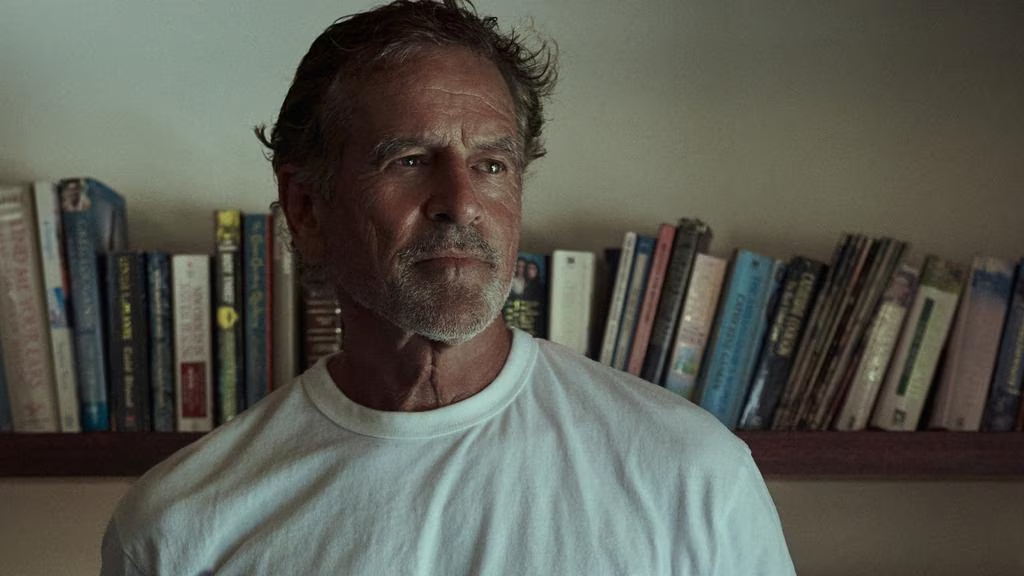
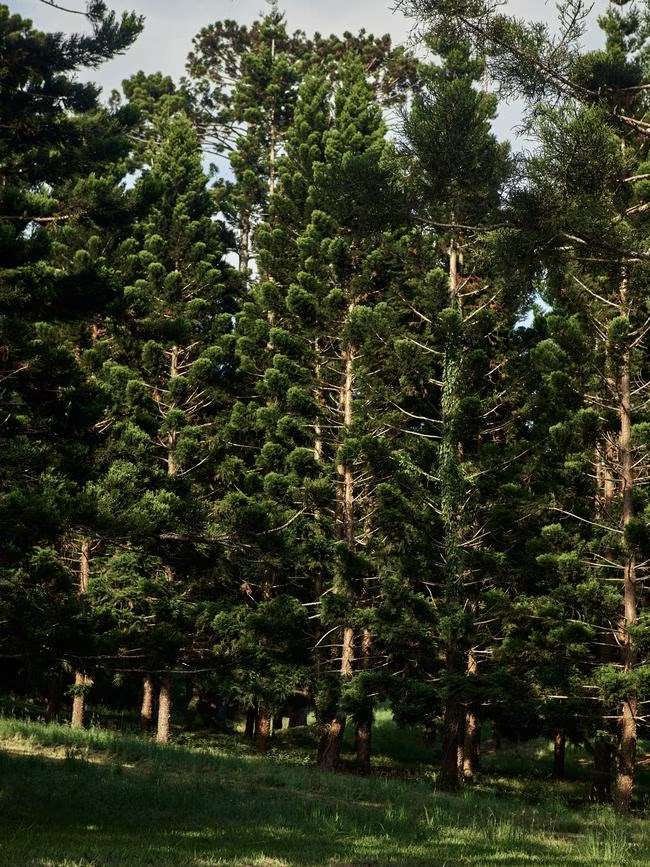
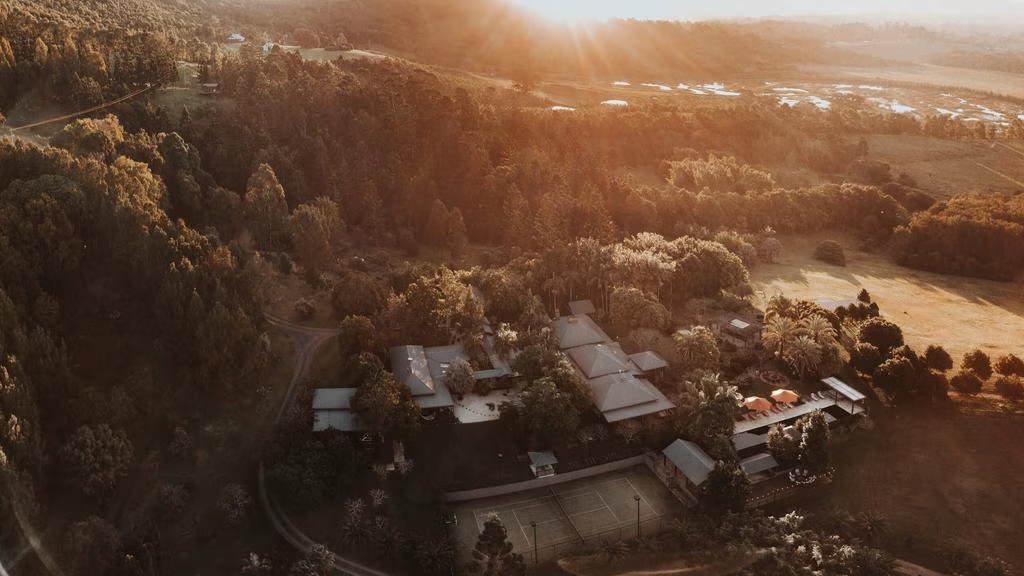
Hundreds, maybe even a thousand olive trees decorate a slope of Belle Helena, Mark Bouris’s secluded property in the Byron Bay hinterland of Far North NSW.
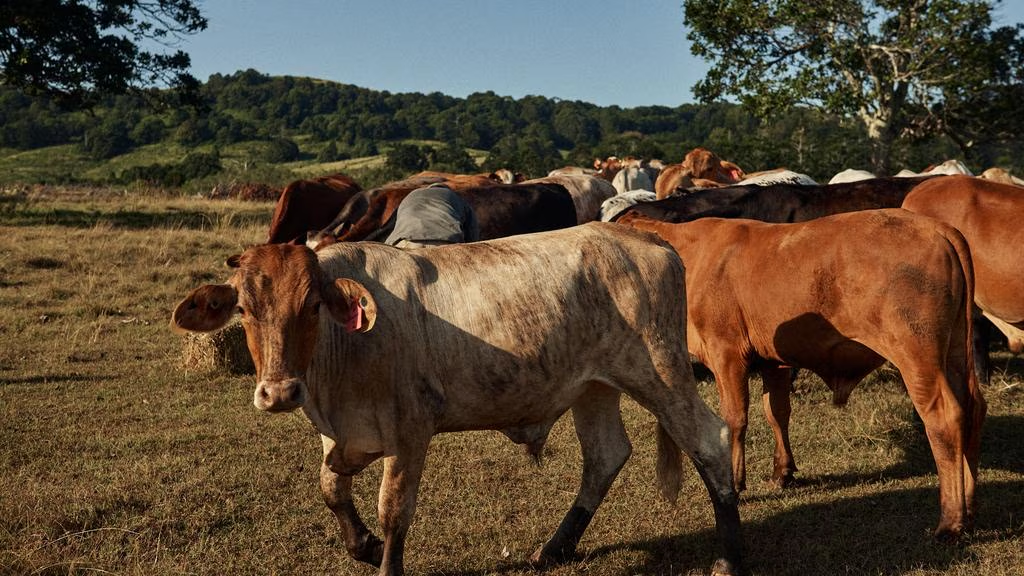
I say decorate, because according to Trent, the investor’s head groundskeeper, they’re not exactly prolific. “They’ve produced fruit three times in about 20 years,” he chuckles as we walk past the trees on the way to check on the 31 teenage steers grazing across the 80-hectare property.
Bouris says he planted the grove of olive trees “so my dad could come in here and pick the olives like he was back in Greece”.
George Bouris grew up on a farm in the mountains of Greece before emigrating to Australia. “My dad’s Greek. My mother’s Irish, Irish Catholic,” Bouris says. “They met here in Australia and I was brought up Catholic.”
The lack of olives is hardly surprising, given Byron’s humid climate is no friend to Mediterranean crops. And for Bouris – who founded Wizard Home Loans in 1996 and sold it less than 10 years later for $500 million – it may be one of the few investments in his life that has stubbornly refused to deliver measurable returns.
His reason for buying the property 25 years ago was, characteristically, practical. “He’s telling me how much it cost him,” Bouris says, recalling a friend describing an expensive European family holiday. “And I said, ‘Mate, that’s the reason I bought this property. I thought I’d just buy a joint, come up here and cut costs’.”
The plan didn’t unfold exactly as expected.
“And, of course, that never occurred because I divorced shortly thereafter,” he says.
His sons still come up, although not necessarily with him. “My oldest son’s in his forties, and my youngest son is only 30, but they come up here without me. They don’t want dad hanging around.”
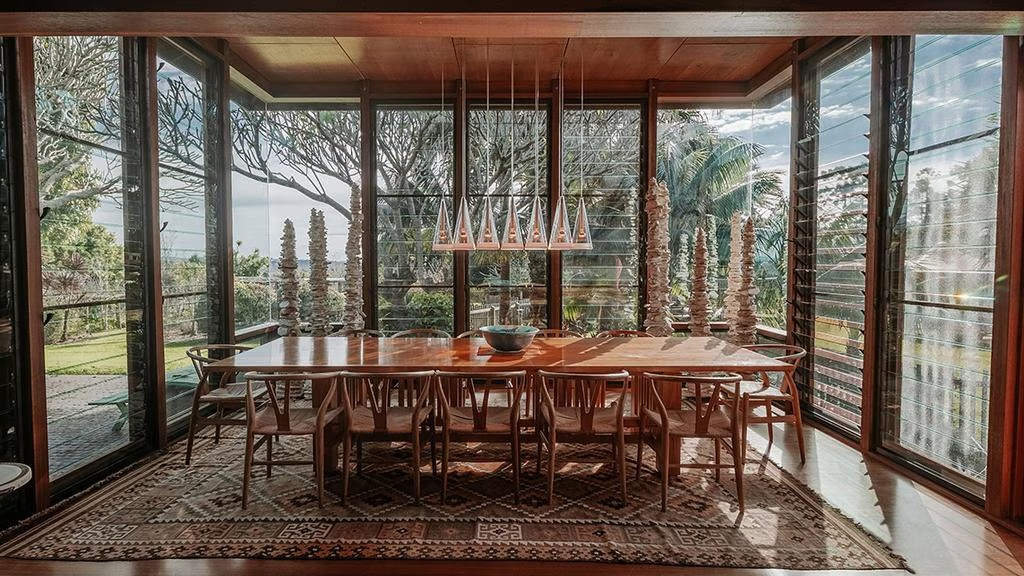
The once-private family estate now doubles as a luxury retreat for hire, with a cabana-lined infinity pool, gym, sauna, tennis court and vegetable garden surrounding the relaxed main homestead.
“I’ve transformed this place over time … into a working property,” Bouris tells the small group gathered here to grill the Melrose Health FutureLab ambassador on his health hacks and the secrets to his youthful vigour. “I really do believe that places like Sydney, Melbourne, Brisbane become so hectic … and I see a place like this as a place of peacefulness because the most important thing in life, I think, if you want to live longer and better, is being peaceful … in your mind.”
Bouris, who is casually dressed today in a white T-shirt, black shorts and trainers, looks strikingly fit. He could pass for a man a decade younger than the age on his driver’s licence.
“I’m 70 this year, so it’s a pretty big year for me,” he says candidly. “It’s got a zero behind, so that usually means something.
“And over the past few years … I’ve become really conscious of not doing those things which will take away from being healthy, living a long time and living well during that long period of time.”
His ambition to reach 100, he says, is driven largely by family. For years Bouris visited his father every Saturday, speaking Greek and listening to stories about the old country. One day he asked him what he considered the greatest achievement of his life.
His dad didn’t answer straight away: Bouris’s son Alex had just arrived with his own young boy, George. Four generations of Bouris men were all sitting together in the backyard.
“My dad looked at me and said, ‘This’,” Bouris recalls. “Being able to sit here with my grandson, my great-grandson, my son and myself.”
Driving home, Bouris did what he instinctively does when assessing something meaningful. He ran the numbers. “The average Australian male lives to about 81,” he says. “When I worked it out, I realised I had about 11 Christmases left. Eleven birthdays. That’s not much. It’s not enough.”
That calculation became the catalyst for what he now calls Project 100 – his attempt to work out just what it might take to live for a century.
The former host of The Apprentice Australia approaches the task the same way he built his financial career: methodically.
He stresses that he’s no scientist. “My academic career is in financial modelling and I have a law degree”, but a combined mix of curiosity and skepticism has led him down plenty of biohacking rabbit holes in recent years. “Science-based answers are all that matters,” he says. “I’m not interested in all the bullshit.”
The same approach shapes his Project 100 podcast, on which Bouris interviews neuroscientists and longevity researchers and pushes them for explanations that go beyond wellness slogans. He prefers to work backwards from what he wants to be capable of at 90: travelling, climbing stairs, carrying luggage. And keeping pace with a younger, female, companion. “What are the things I want to do when I’m 90?” he asks. “I want to look at a church or walk up a mountain… so you’ve got to be able to have strong legs.” Then he adds, with typical bluntness: “What about if I’m walking up the stairs … I happen to have a young woman with me. I don’t want some young woman to say, as my companion, ‘I don’t want to hang around this old f**k, he can’t even get up the stairs’.”
“So, it’s about being relevant relative to the functions you want to be able to form at a future date,” he says. “You’ve got to be able to do it now and start to build up as your system diminishes.”
Supplements sit inside that framework. Bouris has no issue with them in principle, but hype is another matter. “I’m not interested in whether [American neuroscientist and podcaster] Andrew Huberman said [something’s] good. I’m interested in what the science says about it.”
Technology occasionally enters the process, too. Bouris admits he sometimes runs supplement ingredients through AI. “I’ll feed ingredients … and ask it, ‘How does that suit me?’,” he says.
The theatrical side of the longevity industry holds little appeal. American tech entrepreneur and biohacker Bryan Johnson, who reportedly spends millions each year attempting to slow his ageing, is one example. “I’m not crazy like [Johnson], I’m just practical,” Bouris says. “I’m not spending $2 million a year on this stuff.”
He is also realistic about the risks carried from earlier in his life. Bouris is a former amateur boxer who fought professionally twice. He estimates he took 20,000 blows to the head during decades of sparring but these days shuns head contact altogether. “It’s not good if you’re worried about dementia.”
His concern about brain health intensified after learning he carried a genetic risk for dementia. Bouris sought advice from medical experts, including a professor whose own father had died from the disease.
“He said, Mate, no matter what happens, you should be doing high-intensity exercise anyway’,” Bouris recalls. “Now I’ve just got a reason for it.”
Exercise and sleep now sit at the centre of his longevity strategy. He aims for – and usually achieves – at least 30 minutes of high-intensity exercise daily. Sleep, however, is less predictable but he tries to honour his new 9.30pm curfew, which involves a strict dinner policy. “If I can’t eat before six, I don’t eat,” he says.
Asked whether he wishes he’d prioritised sleep earlier in life, Bouris is pragmatic. “When I set Wizard up … no joke, I slept on the floor in the office,” he says. “I had no choice. I had nothing. Zero. No one gave me any money.”
The businessman turns pensive when WISH asks him for his thoughts on what happens when the longevity stacking stops working. After losing his mother to neurodegenerative disease, Bouris began thinking more about the relationship between science and faith.
“Religion is about belief, science about knowledge,” he says. “But I think they can be reconciled.”
“Energy doesn’t disappear or go away. It just changes form. I believe that when we die, our energy and our consciousness … joins up with all the consciousness that exists today.”
The olive grove Bouris planted so that his father could feel Greece beneath his feet again involved the same long-term thinking that his son is now applying to his own life. That is, building routines he hopes will pay off and keep him stair climbing into his nineties.
His father’s version of success was four generations sitting together in a backyard and, it turns out, Bouris wants something like that, too. In his world, longevity is about making sure there’s still time left when the next generation pulls up a chair.
This story is from the April issue of WISH.
FULL STORY